


2
Acoustic
Air & gas leaks, bearing
degradation, cavitation
3
Visual (RGB)
Corrosion, visible defects,
general condition
1
Thermal
Hotspots, overheating, thermal
imbalances
Gas
CH₄, CO, H₂S, O₂, VOC
6
Vibration
Contactless - Early mechanical faults
4
3D perception
Localization, mapping,
anomaly positioning
5
6
1
2
5
3
Designed for real industrial conditions.
Each configuration is defined with on-site teams, based on your operational priorities.

Why a ground based robot?
A ground-based robot addresses all your constraints by enabling stable movement, repeatable paths and continuous inspection.
Assets are spread over large areas
Inspections are still mostly manual
Many anomalies are detected too late
Access is difficult or hazardous
With NetForge, inspections become continuous.
By performing autonomous rounds along the same routes, at the same locations, a ground-based robot turns inspections into time-series measurements, not isolated observations.
Up to 3x/day
Autonomous inspection rounds
More than 10
Measurements per inspection route
Less than 80%
Human exposure in hazardous zones

The robot adapts to the site, not the other way around.
-
Stable locomotion on uneven industrial terrain
-
Indoor & outdoor operation
-
Predefined and repeatable routes
-
Inspections performed in nominal operating conditions
-
No scaffolding, no shutdown, no human escort
Multiple physical signals captured in a single inspection round
-
Electrical hotspots on switchboards and power distribution equipment
-
Abnormal thermal gradients indicating contact resistance or insulation degradation
-
Motor and bearing overheating under load
-
Thermal losses and imbalance in thermal and utility networks


From raw measurements to actionable industrial insight
What was previously manual, episodic and subjective becomes autonomous, repeatable and objective.
-
Earlier detection of thermal, mechanical and environmental drift
-
Reduced human exposure in hazardous or difficult areas
-
Objective, comparable data across time
-
Clear prioritization of maintenance actions
Adapted to your use-cases.
Industrial environments are non-standard. Your hardware should be too. We treat the Slogy platform as a modular foundation, engineering the payload, shielding, and compute stack to match the specific constraints of your facility.
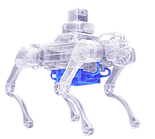


Custom Payload
Slogy features an open rail system allowing for the rapid integration of specific instruments—from gas spectrometers and thermal cameras to acoustic arrays
Adapted to your factory
Whether your site requires IP67 waterproofing, reinforced dust filtration for mining, or thermal shielding for high-heat zones, the chassis is configured to survive your worst-case scenario.

Maximize your ROI
The final hardware configuration; including battery density, connectivity modules, and sensor positioning—is defined during the site assessment to ensure maximum operational ROI.
Answers to common deployment questions
Can the robot handle unstructured environments like stairs or wet floors?
Yes. Slogy is engineered specifically for uneven industrial terrain. It features dynamic balancing for irregular surfaces (gravel, wet concrete) and can autonomously navigate stairs and obstacles. The system delivers up to 4 hours of continuous inspection per charge with a range of 7km, regardless of ground complexity.
What happens if the robot loses network connectivity during a patrol?
The robot possesses onboard edge computing capabilities to buffer all high-fidelity telemetry locally. In signal-denied zones (dead spots), it continues its mission autonomously and synchronizes data with the REX platform the moment connectivity is restored. Data can also be retrieved via physical secure link if needed.
Is it safe for the robot to operate alongside human workers?
Using 360° LiDAR scanning, the robot constantly maps its surroundings for dynamic collision avoidance. If a human operator is detected in its path, the system executes an immediate stop-and-wait protocol, always yielding right-of-way to personnel.
How long does the initial deployment and mapping take?
Deployment is rapid and minimally invasive. For a standard facility, the initial site scanning and data capture takes approximately half a day. Full 3D digital twin generation and route definition are typically completed within 48 hours. This is a one-time initialization process.
Do we need internal robotics expertise to maintain the fleet?
No. NetForge is designed for facility managers, not robotics engineers. The system is fully managed via our software interface. For hardware maintenance, we offer comprehensive support tiers that include repair handling and rapid unit replacement services to ensure your inspection continuity is never disrupted.
